Patient guide
What dental veneers are and what they correct
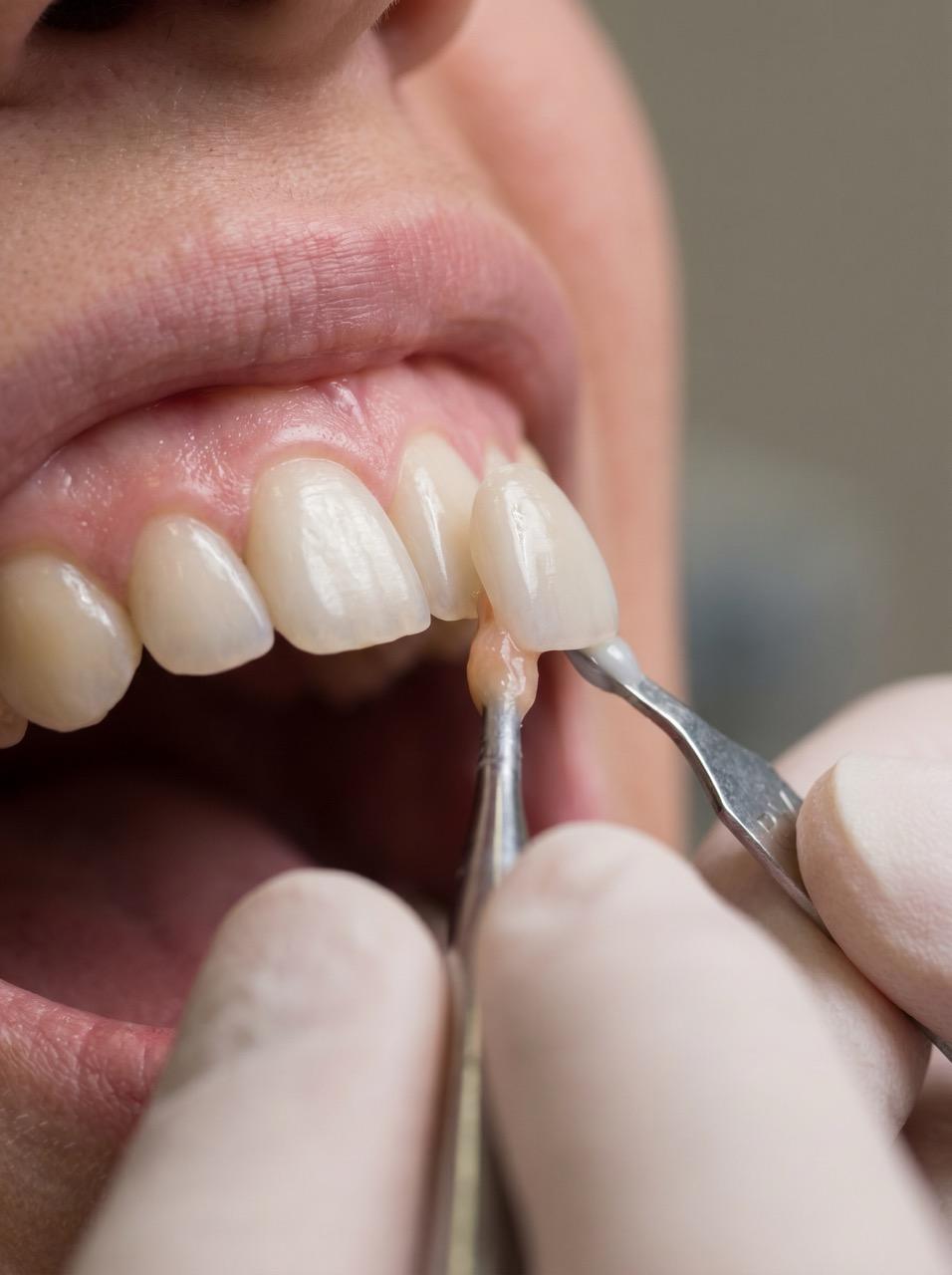
Dental veneers are thin shells bonded to the front of the tooth to correct colour, shape, size or small differences in position. They do not move teeth and they do not replace orthodontics: they change what is seen, not where the root is.
That is why the first step is never to prepare a tooth. It is to study what bothers you about your smile and decide whether the answer is veneers, whitening, aligning first, or a more conservative restoration. Sometimes the best veneer is the one you do not need.
Composite or porcelain veneers: the real differences
The practical difference is the material and how they are made. Composite is worked directly on the tooth in fewer sessions and costs less; porcelain (disilicate or e.max) is made in a laboratory, is more resistant, does not stain and lasts longer.
Typical lifespan differs too: composite veneers usually hold up five to eight years and porcelain ones ten to fifteen or more, always depending on your hygiene and habits (bruxism, coffee, tobacco). Which suits your case and budget is decided at the first visit.
- Composite: fewer sessions, lower cost, reversible.
- Porcelain: more resistant, colour-stable, minimal but permanent preparation.
- In both cases maintenance and habits make the difference.
- If there is bruxism, it is addressed before or alongside to protect the work.
Digital design and the mock-up: seeing them before deciding
Before touching a tooth we project the result with digital smile design (DSD) and try it in your mouth with a mock-up: temporary material placed without any drilling so you can look, take photos and decide with the smile on.
That step is what prevents surprises. If something does not convince you — the length, the shape, the shade — it is adjusted in the design, which is where changing is cheap. Only when you like the design do we move to the definitive work.
What can be undone and what cannot
Composite veneers are reversible. Porcelain ones involve minimal tooth preparation, so they are considered permanent: they can be replaced over time, but the tooth does not go back to its original state.
That is why we insist so much on the prior design and the mock-up. An aesthetic decision should not be made blind, least of all when it is hard to undo.